1000x Plinko Games
High-Risk “1000x” Plinko Games – How They Work and Why They’re Different
Plinko's a dead-set simple game – you lob a ball down a triangular pegboard, pick your bet, dial in the risk, and watch it ping-pong its way into one of the slots at the bottom. In high-risk Plinko (what we call “1000x Plinko” round these parts), the game lets you crank the volatility right up to the redline – tiny chances of hittin' but massive paydays (up to 1000x or more). You'll find these beauties all over crypto casinos like Crypto-Games, ETHCasino, BC.Game, Rakebit, and the like. Most of 'em are provably fair – that means a cryptographic seed/nonce RNG calls every drop, so the result's genuinely random. You can usually suss out the seed's hash before you have a crack and verify the result after – it's a bit like “betting on a horse race that's already been run”. That flashy ball-drop animation? Just for show, mate – doesn't change the outcome one iota.
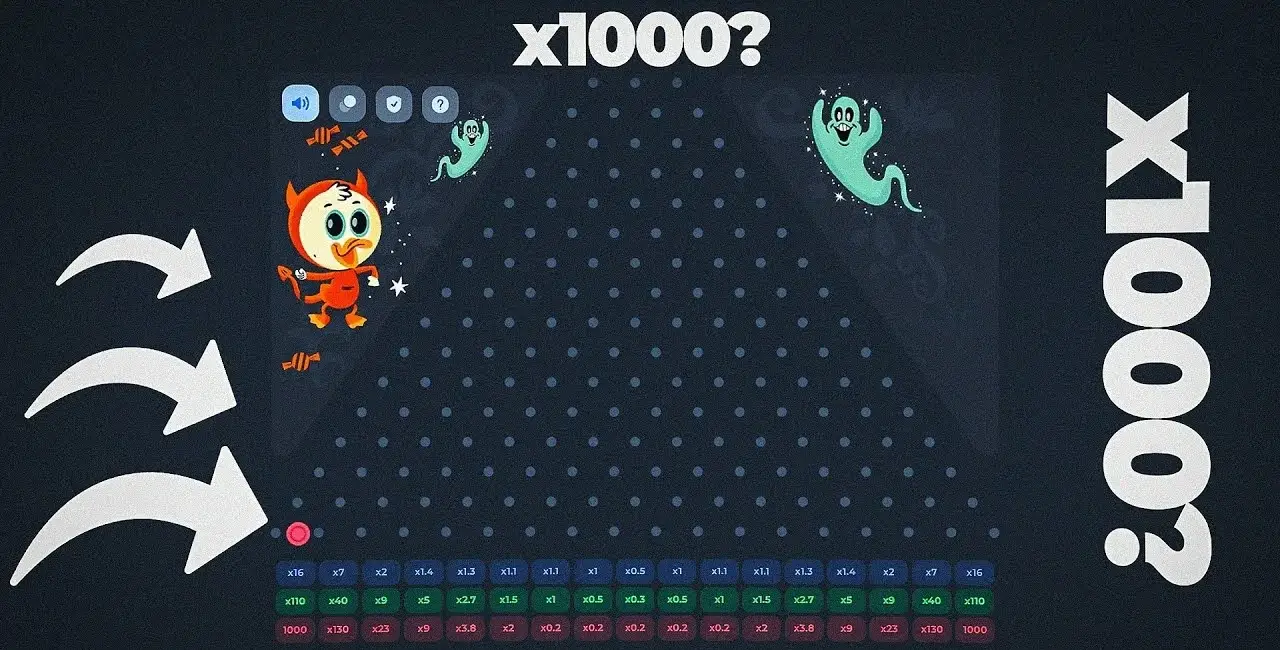
In practice, a high-risk Plinko game works like this:
- Risk Level: You pick your volatility (usually Low/Medium/High). Low risk gives you frequent little nibbles, high risk makes those massive edge slots (like 1000x) possible – but they're rarer than rocking horse poop
- Rows/Pegs: You choose how many rows (typically 8–16). More rows mean more slots and generally fatter edge multipliers. For example, Stake's Plinko lets you go from 8 up to 16 rows; playing 16 rows at High risk unlocks the 1000x slot. More rows = a wider pyramid and more ways for the ball to zig-zag – which bumps up mid-board payouts but also creates those ultra-rare side slots
Once you've set your bet, risk, and rows, you hit “Play” (or Autoplay) to drop the ball(s). The ball bounces around like a startled kangaroo, and where it lands decides your payout: centre slots have low multipliers or even losses, edges have the big bickies. For instance, Stake's own doco shows that on High/16, the centre might be 0.2x (with about ~17% chance), a middle slot might be 9x (~0.85% chance), and the edge slot is 1000x (only ~0.0015% chance – that's lottery territory). By contrast, on Low/8, the “best” slot is only around 5.6x (about 0.39% chance). In short, high-risk Plinko skews the payout spread to make monster multipliers possible but bloody unlikely, whereas low-risk versions cap multipliers (often way under 1000x) and hit more often. Rollbit's Plinko interface (the “Total Degen” board) shows the highest-risk setup – the far-right slot pays 10,000x (Rollbit's max) while the centre shows a tiny 0.1x. Notice the “Balls” slider (up to 100) – Rollbit even lets you drop up to 100 balls at once, which is pure mayhem.
Volatility and Risk Levels
Most crypto Plinko games are “volatility switch” jobs where risk level is a slider: Low, Medium, High (or colour-coded green/yellow/red). As one guide puts it, “High-Risk Mode: Huge potential multipliers (up to 1,000x or more), but with a much lower probability of hitting 'em. High variance and more volatility”. Low/Medium risk gives you a steadier ride. For instance, a well-known strategy site notes that at Low risk you get “frequent, but modest” wins, while Medium is balanced and High yields rare big hits – the classic boom-or-bust.
In practical terms, setting Low risk tilts the board toward the middle: you'll hit smaller multipliers (often under 10x) more regularly. High risk pushes huge numbers (hundreds or thousands) to the edges. Stake's blog confirms that “the more rows and higher volatility you select, the more chances for big payouts – but also bigger losses”. The risk slider doesn't change the maths of each drop (every slot's hit chance is set by the board), but it shifts the multipliers – e.g. the same slot might be 3x at Low risk and 30x at High risk.
Bet sizing also ties into risk: betting bigger doesn't improve your odds, it just scales your payout when a win lands. (For example, a 1.3x slot pays $1.30 on a $1 bet or $13 on a $10 bet). Experienced punters hammer home the importance of bankroll control. One advice blog says it's best to “set a budget and split it into many small bets”, since “it's always better to play with smaller stakes than risking most of your bankroll at once”. In other words, even though big bets can multiply your wins, they'll also clean you out faster than a seagull on a hot chip.
Pegboard Configuration and Payouts
The number of rows (pegs) fundamentally changes the game. More rows create more peg collisions and more landing slots. In a typical setup, an 8-row board has 9 bottom slots; a 16-row board has 17 slots. The outer slots (one on each side) always pay the highest multiplier. According to Stake's own tables, an 8-row/Low-risk board might have a max payout of only ~5.6x (the edges), whereas a 16-row/High-risk board can push to 1000x. Increasing rows increases the “spread” of outcomes. One guide notes that “if you increase the number of rows, you'll unlock bigger payouts on the edge of the board. However, it also increases the number of small payouts in the middle”.
In practice, on a 16-row high-risk board most outcomes will land near the centre (low multipliers like 0.2x or 1x), and only an astronomically small fraction (~0.0015%) reach the far edge (1000x). That's probability theory in action: with 16 binary bounces, hitting all left or all right (to reach an outer slot) is about 0.0015%. The game's RNG literally generates 16 coin-flips per ball. When you hover over any slot (most games let you do this), you'll see its hit probability and payout.
For example, one deep-dive on Stake Plinko shows: at High/16, the centre 0.2x slot has ~17% chance, a 9x slot ~0.85%, and the 1000x slot only ~0.0015%. By contrast, at Low/8, a 0.5x slot might hit ~27% and the top 5.6x slot ~0.39%. These illustrate the trade-off: High-risk boards yield rare mega-multipliers; low-risk boards yield frequent small multipliers – pick your poison.
Provably Fair Randomness
A key feature of crypto Plinko is its provably fair algorithm. Unlike traditional casinos, most crypto sites generate each drop with a verifiable hash: a secret server seed (plus optionally a user seed) is hashed and shown to you before you play. After the round, the site reveals the seed so you can recompute the outcome yourself. For example, Rakebit explains that a cryptographic hash of the secret seed is published pre-bet to prove it wasn't changed later, and after play you get the “path” string (a series of “+” or “–” for right/left at each row) so you can independently verify every ball's route. Stake's official Plinko page likewise confirms it's provably fair. It notes that “Plinko is a provably fair game in which results are generated using a provably fair system”, so outcomes are truly random. (Stake even exposes its hash via an “acorn” icon). In practice this means you can't be cheated: every round's result is determined purely by the seeds and the game's code – no “rigging”. Even though some punters swear they see patterns, the maths holds that each ball's bounce sequence is precomputed by the RNG.
Autoplay and Multiball Features
To make high-volume betting easier, most Plinko games offer Autoplay/Autobet. Instead of clicking “Play” each time, you set a number of automated drops with your chosen bet and risk settings. This lets you run hundreds of balls quickly (often with animations sped up or even turned off). Stake, for example, supports auto-betting with a “number of bets” parameter, plus hotkeys (spacebar to drop balls fast) and an “instant play” option to skip animations. These features simply save you from repetitive clicking – they don't change the game's odds or randomness one bit.
Some sites take it further with multi-ball or multi-drop modes – you can drop several balls at once. Rakebit's Plinko has a “Multi Drop” slider letting you drop up to 100 balls in one go – the balls fall simultaneously or in quick succession. (See the embedded Rakebit screenshot: the “Balls” slider ranges 1–100). Multi-ball multiplies your chances of hitting something on a single “round,” but each ball still follows independent randomness. It's simply a volume play (and makes watching for rare big hits more exciting). Most other platforms don't have official multiball, but their Autoplay achieves a similar effect by running many single drops rapidly.
Pros & Cons of High-Risk Plinko
Pros: High-risk Plinko is a ripper of a thrill and simple as chips. Anyone can play – just drop a ball – yet the chance of a life-changing win adds plenty of spice. It offers customisable volatility (choose low or high risk) unlike many casino games. It's also fast and addictive: Plinko is “fast-paced action” with instant results. In crypto casinos it's typically provably fair and anonymous, with low bet limits (you can play for pennies up to thousands) and quick crypto payouts. The huge multipliers – and yarns of 1000x+ wins – draw heaps of players.
Cons: On the flip side, extreme volatility is unforgiving – it'll bite ya. High-risk Plinko has a decent house edge on individual rounds (1–5% typical, e.g. Stake's is 1%) and the biggest slots almost never hit. This means most of the time you lose or just get back a fraction of your bet. As one review warns, “High risk at extreme levels – playing at high volatility can lead to frequent losses”. The game is pure luck (no real strategy can “beat” it), so chasing rare wins often wipes out players' balances. Fast autoplay can also encourage chasing losses or going on tilt. Lastly, while crypto Plinko offers privacy, it can expose you to crypto price swings and unregulated sites – you've gotta trust the provably fair system.
In short, high-risk Plinko is a double-edged sword: potentially huge wins vs. near-certain grind. As one guide concludes, “low-risk strategies are the best way to make a profit in the long run – hitting 1000x… odds are very low”. Many experts advise treating 1000x as a fun long-shot, not a game plan.
Tips & Strategies
Start low to learn the ropes. If you're new, begin on low or medium risk with fewer rows. That means more wins (even if small) so you can see the game's behaviour without bleeding out. Many casinos let you try demo/fun mode for free – use that to watch slot odds and get comfortable. Set a bankroll and stick to it like glue. Decide how much crypto you can afford to lose. Break it into many small bets – it's better to make 50 rounds at 1% of your bankroll than 5 rounds at 10% each. Progressive betting (Martingale, D'Alembert, etc.) is possible but extremely risky in Plinko due to the rare losses – one big miss can wipe out your whole sequence. Only try such systems with play-money or very small stakes.
Use Autoplay/Multiball wisely. Autoplay is handy for observing long-term patterns (even though each spin is independent). But remember, past spins don't influence future ones – that's the gambler's fallacy, mate. Multiball (where available) can land a jackpot in one run, but it's still random for each ball. Weave in regular manual play to stay alert. Understand the odds – hover over slots to see hit percentages. For example, on high-risk boards the outer 1000x slot is typically under 0.002% chance. That means thousands of drops on average per hit. If you do chase it, know you're betting on a statistical tail. Many pros warn: “the odds of hitting 1000x in Plinko are very low, so I'd advise against high-risk strategies that rely on it (unless your bankroll is very large)”.
Play responsible, cobber. Treat Plinko as entertainment, not an investment. Set win/loss limits and take breaks – don't let the green-eyed monster get ya. High-risk Plinko can trigger fast swings. Remember that even though the option of 1000x exists, the expected value per round is usually slightly negative (house edge), so over time you'll lose. Good bankroll management and a cool head are your best “strategies” in the long run.
Popular 1000× Plinko Platforms
- Stake.com (Stake Originals): Stake's in-house Plinko is provably fair with 1% house edge. You can play for fun (with gold coins) or real (crypto). It has the classic sliders: 3 risk levels (Low/Med/High) and 8–16 rows. Only on High risk with 16 rows do you get the 1000x slot. Stake highlights this on its blog and in-game tables. Autoplay, hotkeys, and “instant play” (no animation) are supported. Hovering shows each slot's win chance. Stake even cites odds: at High/16 the 1000x has ~0.0015% chance. Many punters consider Stake Plinko the gold standard because of its transparency and high max payout.
- BC.Game: BC.Game's proprietary Plinko also offers a 1000x max payout. It runs at 99% RTP (i.e. ~1% house edge), with 3 volatility modes and 8–16 rows just like Stake. Their odds are nearly identical: 1000x is about a 0.0015% hit on high risk. BC.Game is fully provably fair – you can verify drops on-chain via their UI. In short, BC.Game gives the same mechanics (risk slider, row slider, Autoplay) and win table as Stake, just under their branding. It's a favourite for crypto gamblers who know the payout structure well.
- Rollbit: Rollbit's Plinko (launched late 2022) is currently the most extreme – it tops out at 10,000x per ball, well above 1000x. Rollbit achieves this with special “Degen” boards: you still pick risk (Low/Med/High) and 8–16 rows, but you can choose “Degen”, “Extra Degen”, or “Total Degen” mode. These auto-lock to extreme risk and higher row counts (12, 14, or 16 rows). The “Total Degen” board (16 rows, High risk) is where the 10,000x lives. The Rollbit interface (see above) shows the giant outer slots like 10,000x, 3333x, 1000x and so on. Rollbit also has a true multiball feature: you can drop up to 100 balls in one click. As with other Provably Fair games, every Rollbit spin's seed hash is logged and you can self-verify the result. (One caveat: Rollbit's extreme games carry higher house edges on “Extreme” boards, as noted on their site.) Even if you don't care about maths, its screenshot and 10kx prize draw are eye-catching.
- Others: Other crypto casinos follow similar templates. For example, BetFury and some Spribe/BGaming-based casinos feature Plinko-like games capped at 1000x. BetFury's provably fair version is 99.02% RTP and offers 1014x max at High/16. Many alt-casinos (BitStarz, BC.Game NG, etc.) use either in-house or third-party Plinko with high volatility options. If a site advertises a “1000x Plinko”, it almost certainly mirrors the stake-style mechanics above. Always check if it's provably fair (look for a hash icon) and review their RTP/edge before you have a punt.
In summary, high-risk Plinko (aka “1000x Plinko”) is a volatile, fast-paced crypto casino game – pure Aussie battler territory. It works by letting you dial up rows and risk to chase giant edge-multipliers, at the cost of much slimmer odds. The payout at each slot is preset and publicly visible, and the RNG seed ensures fairness. Popular crypto platforms like Stake, BC.Game, and Rollbit all offer these games: on Stake or BC.Game the 1000x slot is the ultimate prize at high volatility; Rollbit pushes beyond to 10,000x on special “Degen” boards. Whether you're a beginner or a seasoned pro, success comes down to luck plus smart risk management. Start small, know the odds, and play responsibly – then maybe that tiny 0.0015% chance will hit for 1000x or more! And if it does, mate, you're shouting the bar.
Sources: Authoritative guides and casino sites (Stake, Rollbit, etc.) explain Plinko's mechanics, risk settings, provably fair algorithm, and payout tables – all the good oil.
- What are the chances of hitting the 1000x - Page 3 - Plinko - Stake Forum
- Introducing Rollbit Plinko blog.rollbit.com/rollbit-plinko/
- Understanding Plinko Odds: A Guide https://casination.net/plinko-odds
- Plinko Casino Game Review 2025 | How It Works & Where to Play https://casino.guide/plinko/
FAQ About 1000x Plinko Games
Okay, picture this: you drop a puck down a Plinko board, and instead of small multipliers, you’re chasing that insane 1000x multiplier. That means if you bet 1 coin, you could theoretically win 1000 coins in one drop. These games crank up the volatility to the max — one spin can make or break you big time.
The magic’s in the board layout and the multiplier slots at the bottom. These high-risk Plinko games have very tiny slots with huge multipliers (like 500x, 1000x), but hitting them is rare because the puck has to bounce just right through a gauntlet of pegs. The odds of hitting these big multipliers are super low — but if you nail it, boom, huge payout. The game’s RNG (random number generator) or provably fair system controls those bounces, so it’s all digital luck with some math behind it.
High-risk means the odds of losing your bet are crazy high. The house edge or built-in advantage might be similar to normal games, but since the jackpot spots are so tiny and rare, you’re more likely to lose a bunch of small bets before hitting something decent. Betting big is like lighting money on fire — sure, you could win a 1000x, but you can also burn your whole bankroll fast. It’s a thrill ride, not a savings plan.
Regular Plinko usually has more balanced multipliers (like 2x, 5x, 10x) spread evenly across the board, so your chances of winning something small or medium are decent. High-risk 1000x Plinko cranks those multipliers up but slims down your chances to nearly nothing. It’s basically the difference between playing safe poker and going all-in on a long shot. One’s steady, the other’s adrenaline-fueled chaos.
Mostly luck, but players get crafty with risk management — choosing different drop zones on the board can change their odds slightly. Some spots might have better odds for middle multipliers but no chance at 1000x, while others go all in on the edges for those massive wins but with a higher bust rate. Knowing your risk tolerance and sticking to a plan is as close to skill as it gets.